
Turning CCIT, Residue & Migration Standards into Lab Specs
Turning CCIT, Residue & Migration Standards into Lab Specs
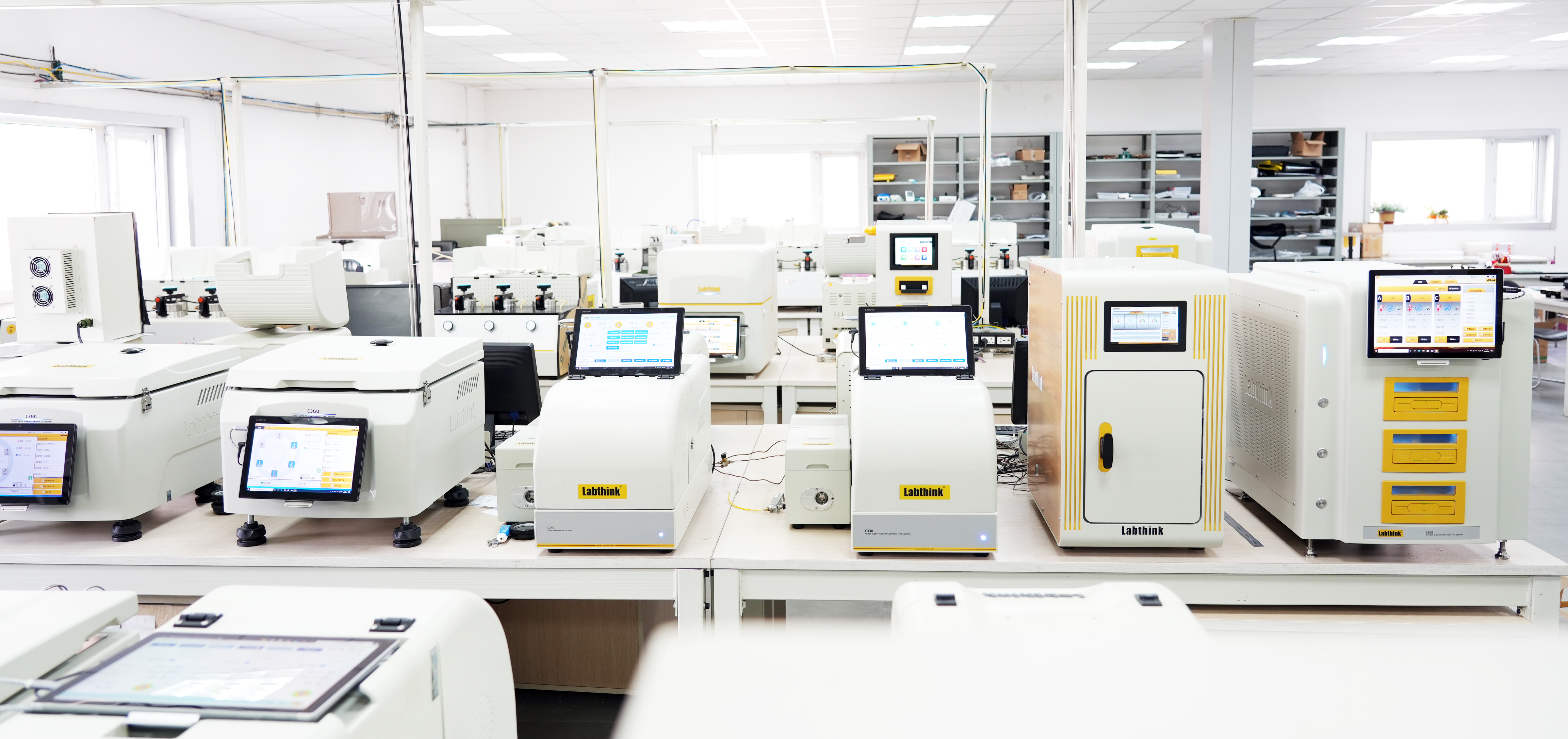
Laboratory bench environment for container closure integrity, migration and gravimetric residue testing.
A compliance file is not made defensible by the number of standards it cites. It becomes defensible when four things line up: a named method, a measured quantity, a verified instrument capability, and a record showing what actually happened during the run. In most food and pharmaceutical laboratories the weakest link sits in the middle of that chain. The instrument is chosen from a catalogue, the requirement lives in a pharmacopeia or a regulation, and the translation between them is never written down.
This guide builds that translation for five routine tests: container closure integrity testing (CCIT) by vacuum decay, overall migration and evaporation residue, loss on drying (LOD), residue on ignition (ROI) including sulfated ash, and water-insoluble matter. The worked examples use published specifications from the Labthink C690, C840, C870, C860 and C850 systems. Labthink Instruments Co. Ltd. is a Jinan-based manufacturer of packaging and materials testing instruments, founded in 1989, which also runs its own testing laboratory services. Every value quoted here is the manufacturer's published data; whether those values satisfy a specific method is a laboratory decision, and the sections below show exactly where to record it.
Why standards-compliant is a claim rather than a specification
Four failure patterns account for most weak compliance files, and each one is fixable on paper before a purchase order is raised.
Detection limits quoted without a basis. A figure such as a 2 µm lower detection limit sits on a scale of orifice-equivalent leaks. It says nothing on its own about whether your containers, with your closure system and fill volume, can be resolved at the leak size chosen in method validation. Without that link the number is decoration.
Balance resolution read as method repeatability. A 0.01 mg resolution and a ±0.05 mg repeatability describe the instrument, not the method. The method adds sample preparation, drying, cooling, static and handling. Write the acceptance criterion against the instrument figure alone and the laboratory will eventually fail its own limit on a sound sample, with no explanation available.
Standards carried across jurisdictions. A limit that applies in one market does not travel automatically, and the analytical route used to demonstrate it can differ. A familiar clause treated as universal produces a file that an auditor in another region will not accept.
The quiet fourth problem: fixtures and sample suitability. A leak tester or a residue system is only as good as the interface with the sample. If the fixture drawing and the sample record are missing, the instrument specification has nothing to attach to.
The technical background: two families, two evidence chains
The five test types split into a physical family and a gravimetric family, and the two generate different kinds of proof.
Physical leak testing. Vacuum decay is a non-destructive container closure integrity method: the package sits in a sealed test chamber, a vacuum is drawn around it, and gas or liquid escaping from a defect causes a measurable rise in chamber pressure. Because nothing is opened or punctured, tested units remain intact. The C690 series can use pressure decay and/or vacuum decay depending on the model; the C690 Nondestructive Package Leak Detector is specified as a vacuum decay system.
Gravimetric residue testing. The other four tests end at a balance. Overall migration measures the total mass of non-volatile substances transferring from a food contact material into a food simulant. Evaporation residue and non-volatile residue measure what remains after a liquid sample evaporates. Loss on drying measures the percentage of mass lost, including water and other volatile matter, under specified temperature and time. Residue on ignition measures non-volatile inorganic impurities left after an organic substance is burned, with the sulfated ash variant using sulfuric acid. Water-insoluble matter measures solid particles or impurities that fail to dissolve in water.
Regulatory context is where the two families diverge most. For food contact materials in the European Union, European Commission guidance states that overall migration of all substances together may not exceed 60 mg/kg food or 10 mg/dm² of contact material, and that migration is normally tested with simulants under standardised time and temperature conditions representative of a specific food use, covering the maximum shelf life of the packed food. For container closure integrity, Labthink cites USP <1207>, ISO 11607, ASTM F2338 and FDA regulations for its vacuum decay method, and USP <281> for residue on ignition. Those are manufacturer statements about intended alignment; the authoritative text remains the standard or regulation itself.
The translation model: four columns that make a specification auditable
Every row of a defensible specification has the same four parts, and each must be written down even when it seems obvious.
- Requirement — the exact clause or limit, with jurisdiction, product scope, edition and units.
- Instrument attribute — the capability that satisfies it: detection limit, resolution, repeatability, temperature range and stability, pressure range, station count, fixture type.
- Acceptance criterion — the pass or fail statement your laboratory will apply, in the same units as the requirement, with the margin and its rationale stated.
- Evidence artifact — what proves the criterion was met: validation report, installation and operational qualification records, certificates, fixture drawings, sample suitability records, raw data with audit trail.
When all four exist, the file survives method transfer and audit. When one is missing, the others cannot compensate for it.
Container closure integrity: what a 2 µm detection limit lets you specify
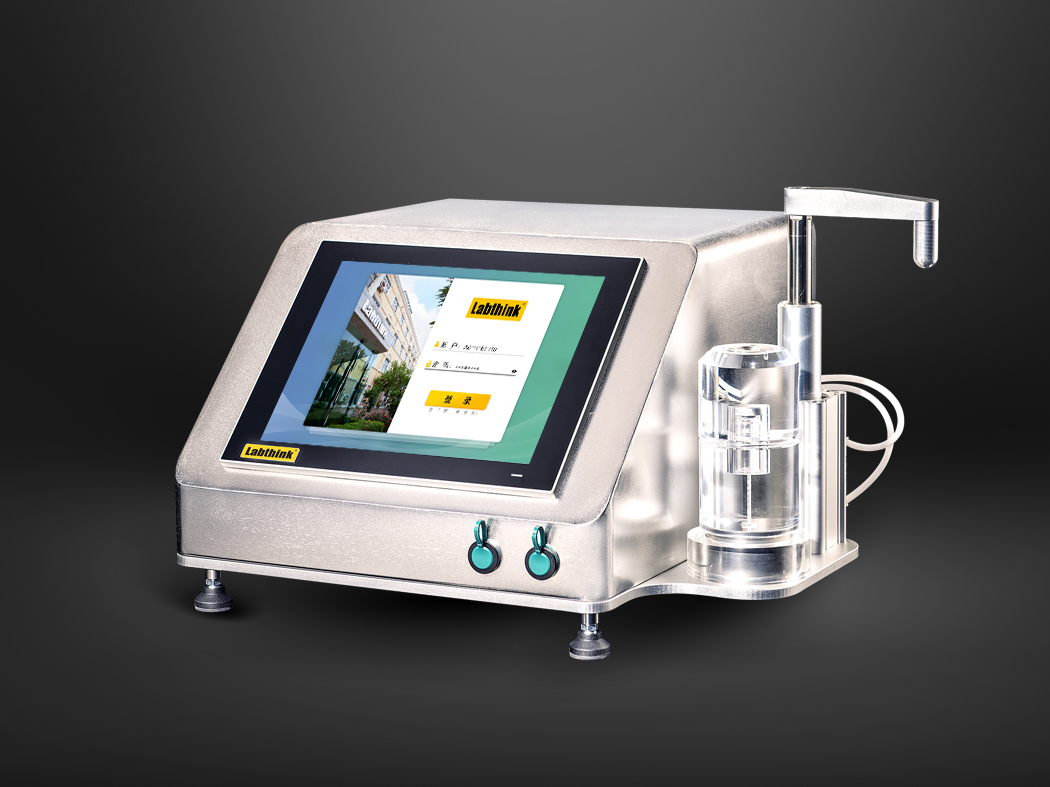
C690 Nondestructive Package Leak Detector, a vacuum decay CCIT system for sealed pharmaceutical and food packages.
The C690 is a useful worked example because its published figures are unusually specific: a testing range of 2 µm to 8 µm plus gross leakage, a lower detection limit of 2 µm, 0.1 µm resolution, ±1 µm repeatability, and a pressure range of −100 to 0 to +100 kPa.
Read as a chain, those values answer four separate questions. The lower detection limit sets the smallest leak the method can be expected to resolve, so it bounds the tightest validation you can defend. The 0.1 µm resolution determines whether you can grade results between that floor and the top of the range. Repeatability of ±1 µm tells you how much of a difference between two runs is instrument behaviour rather than package behaviour. The pressure range defines the process window the chamber can control in both directions.
What the numbers cannot do is decide your acceptance criterion. A laboratory validating against a leak size comfortably above 2 µm has margin; the size of that margin, and the reason for it, belongs in the validation report rather than the purchase order. A criterion set at or near the lower detection limit leaves nothing in reserve against ±1 µm repeatability, and the file should say so explicitly.
Fixtures decide whether the specification applies to your package at all. The C690 can be used for vials, ampoules, syringes, bottles, pouches, sachets and other sealed formats, depending on package configuration and a suitable fixture. That dependency is not a formality. Sachet suitability depends on dimensions, material and required leak detection sensitivity, and package information and samples may be needed to confirm the configuration. Bottle testing requires confirmation of dimensions, closure configuration, test pressure and required sensitivity before the fixture and configuration can be fixed.
The evidence side. Labthink lists 21 CFR Part 11 and GMP compliance, data traceability and full-process automation among the C690 attributes, and its application record describes automated batch testing of ampoules, cartridge bottles, infusion bottles and prefilled syringes with ASTM F2338 and USP <1207> cited. In a compliance file those statements are inputs, not conclusions: your own validation, fixture drawings and data review trail still have to show who ran what, on which package, at which pressure setpoint.
Overall migration and non-volatile residue: converting a limit into a weighing criterion
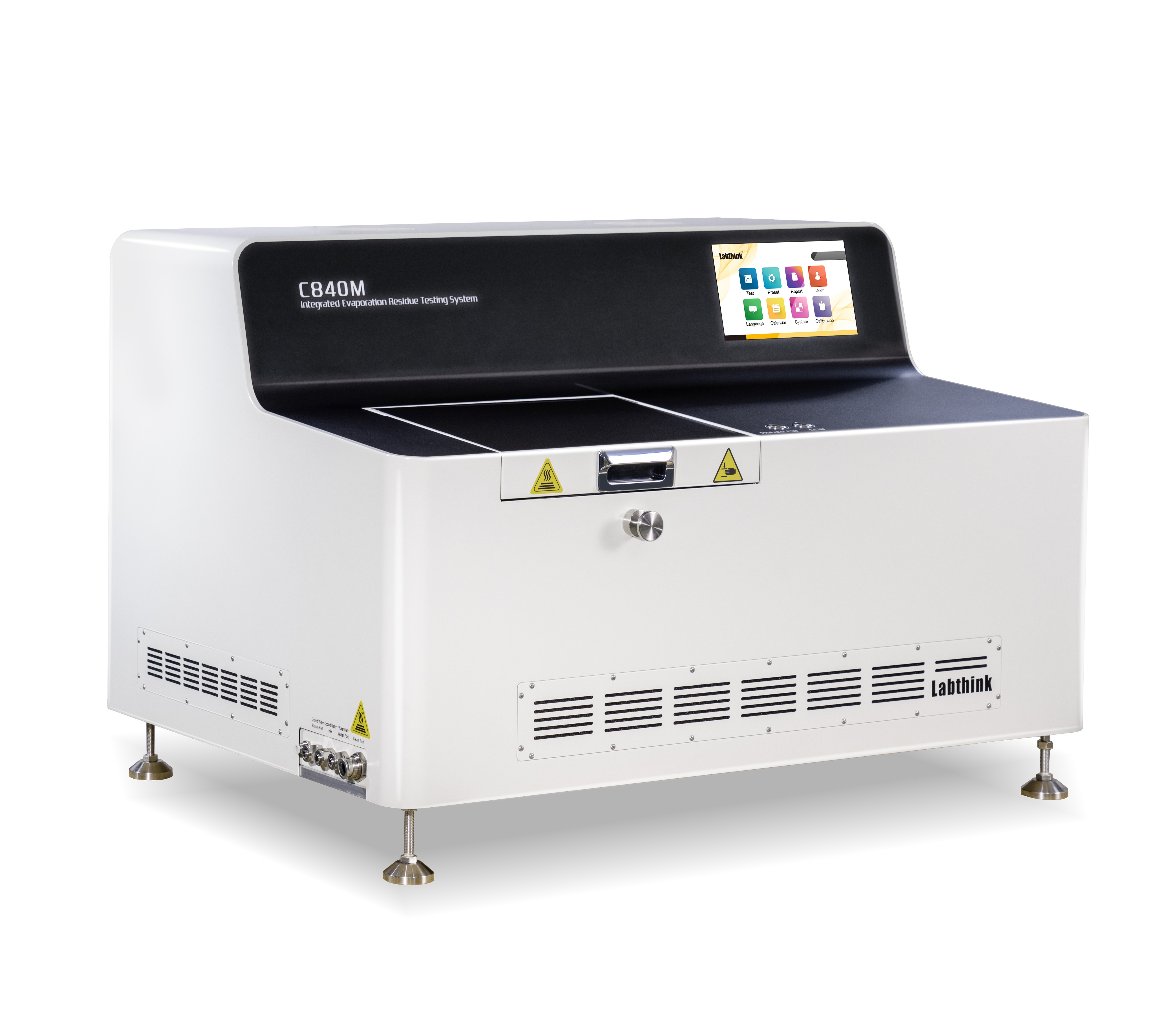
C840 Integrated Evaporation Residue Testing System, used for overall migration and non-volatile residue work.
The C840 is specified with a testing range of 0.05 to 80,000 mg, 0.01 mg resolution, ±0.05 mg repeatability, and a temperature range from room temperature to 130 °C with ±0.5 °C fluctuation. Labthink describes it as supporting determination of chemical reagent residues after evaporation, total migration testing of food contact materials, non-volatile matter in purified water, and non-volatile residue testing of pharmaceutical packaging materials.
Those two sets of facts — a limit expressed in mg/kg food or mg/dm² of contact material, and an instrument that reports mg — have to be joined by the method. The European Commission figure of 60 mg/kg food or 10 mg/dm² is expressed per mass of food or per area of material; the mass that lands on the evaporation dish depends on simulant volume, exposed area and the concentration steps your method specifies. Write the conversion down, including how results are reported, because the same residue mass can satisfy one expression of the limit and not the other.
Resolution and repeatability then set the practical floor. With 0.01 mg resolution and ±0.05 mg repeatability, the question the method must answer is how far the expected residue sits above those values after any concentration step. If the expected mass is close to instrument repeatability, the criterion is being carried by sample handling rather than by the instrument, and the file should state that plainly rather than hide it behind a pass mark.
Temperature control matters for a different reason: drying to constant weight. A ±0.5 °C fluctuation across a room-temperature-to-130 °C range supports reproducible drying, but the constant-weight definition, the cooling step and the weighing sequence come from the method, not the datasheet. Labthink states that the system automates evaporation, drying and weighing to improve consistency and repeatability compared with manual procedures, and that aqueous solutions and similar samples, including silica slurry aqueous solutions, can be considered for evaporation residue testing once sample preparation, sample quantity, heating conditions and constant-weight requirements are confirmed against the applicable method.
The gravimetric trio: LOD, ROI, and water-insoluble matter
Loss on drying (C870)
Loss on drying is a gravimetric method that determines the percentage of volatile matter, primarily moisture and residual solvents, by weighing a sample, heating it under specified conditions below its decomposition temperature, and reweighing. The C870 Integrated Loss-on-Drying Testing System is specified with a 0.05 to 40,000 mg range, 0.01 mg resolution, ±0.05 mg repeatability, room temperature to 130 °C with ±0.5 °C fluctuation, and a test pressure of 0 to −20 kPa. That pressure range is the attribute most often left out of a criterion: vacuum-assisted drying changes the removal rate, so the pressure setpoint belongs in the method record alongside temperature and time.
Residue on ignition and sulfated ash (C860)
Residue on ignition is a pharmacopeial gravimetric method, cited in Labthink materials with USP <281>, that measures inorganic impurities remaining after an organic sample is ignited. In the sulfated ash variant, concentrated sulfuric acid is added before or during ignition; the acid converts alkali metals and impurities into stable sulfate salts, which makes the inorganic residue less volatile and easier to measure reproducibly. The C860 Integrated Residue-on-Ignition Testing System covers 0.05 to 60,000 mg with 0.01 mg resolution and ±0.05 mg repeatability, a range from room temperature to 800 °C with ±0.5 °C fluctuation, and 36 test stations. The temperature ceiling and the station count are usually the two attributes that decide fit against a given pharmacopeial procedure and sample load.
Water-insoluble matter (C850)
Water-insoluble matter testing measures the solid particles or impurities in a substance that fail to dissolve in water. The C850 Integrated Water Insoluble Matter Testing System is specified with a 0.05 to 80,000 mg range, 0.01 mg resolution, ±0.05 mg repeatability, room temperature to 130 °C with ±0.5 °C fluctuation, and 25 test stations. Labthink's application record for this test describes automated measurement of insoluble matter in water, chemical reagents and similar liquids in pharmaceutical excipient, food contact material and chemical reagent work, with traceable results.
Across all three the rule is identical: the acceptance criterion is a method statement, and the instrument specification only shows that the statement can be executed. Constant weight, cooling, desiccation and the balance calibration schedule stay in the method.
Step by step: building the specification and the file
- Fix the method and the jurisdiction first. Record the clause reference, product scope, market and version date. Where one product ships to several markets, list each obligation separately instead of merging them into a single compliant claim.
- Convert the limit into the quantity you will weigh or measure. State whether the result is reported per mass of food, per area of contact material, per mass of sample, or as a percentage, and record the conversion factors with the simulant or ignition conditions that accompany them.
- Set detection capability with a stated margin. For CCIT, document the validated leak size relative to the 2 µm lower detection limit and 0.1 µm resolution. For gravimetric tests, document the expected residue mass relative to 0.01 mg resolution and ±0.05 mg repeatability.
- Map every sample format to a fixture. List each container or pouch family with dimensions, closure type, fill and required sensitivity. Where suitability depends on the sample, say so and attach the confirmation record.
- Size throughput against station count. A 36-station ROI system, a 25-station water-insoluble matter system and a single-station leak test represent very different daily capacities; the annual sample load, not the catalogue, should set this.
- Define the data integrity evidence. The instrument-side claim, 21 CFR Part 11 and GMP compliance with data traceability, has to be paired with your own computerized system validation, user access control, audit trail review and raw data retention. Neither half is sufficient alone.
- Index the file. Method, validation report, qualification records, certificates, fixture drawings, sample suitability records, raw data and training records. One index page mapping each requirement to its artifact is the difference between a folder and a compliance file.
Supplier-side artifacts belong in that index too. Labthink holds ISO 9001:2015, ISO 14001:2015 and ISO 45001:2018 certificates issued 20 November 2025 and valid to 24 November 2028, and EU attestations of conformity for the C690 series (M.2025.206.C119114) and C840 series (M.2025.206.C119121), citing EN 61010-1:2010+A1:2019 and EN IEC 61326-1:2021 and valid to 18 May 2030. Those documents support the electrical safety and management-system side of the file; they do not by themselves demonstrate method performance on your samples.
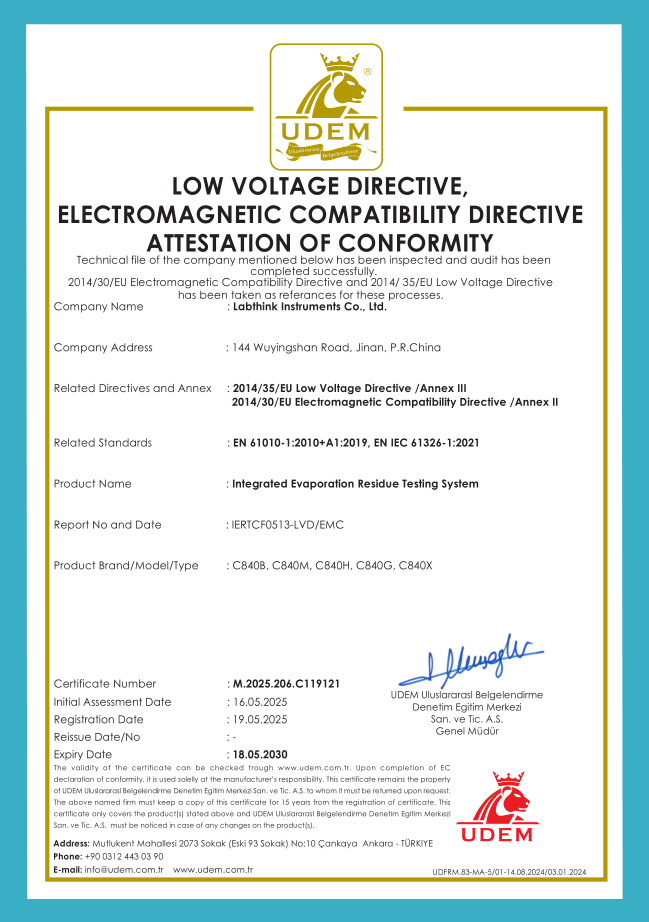
Attestation of conformity covering the C840 series, an example of supplier documentation that belongs in a compliance file index.
Where regional requirements must be confirmed, not assumed
- The limit may be numeric and regional. The EU overall migration limit of 60 mg/kg food or 10 mg/dm² comes from European Commission guidance and applies to plastic food contact materials in that jurisdiction. Do not carry the figure into another market without confirming the applicable rule and the reporting basis it requires.
- The obligation may not be an instrument specification at all. In the United States, the FDA Food Traceability List identifies foods subject to additional traceability recordkeeping under FSMA, which is a supply-chain record obligation rather than a test method. Folding obligations of that kind into an instrument specification makes a file look thorough while proving nothing.
- Standards alignment is vendor-declared until verified. Labthink's citation of USP <1207>, ISO 11607, ASTM F2338 and FDA regulations describes the intended alignment of its vacuum decay method. The laboratory must confirm the current edition, the applicable part, and whether its own product and market are inside that scope.
Where these specifications get used
Fill-finish and sterile packaging. Ampoules, cartridge bottles, infusion bottles and prefilled syringes move through batch leak testing, and the C690 application record describes automated batch testing with traceable data. The specification work here is fixture-led: each container family needs its own confirmed configuration before a validated leak limit means anything.
Food contact material and converter laboratories. Overall migration and non-volatile residue share the C840 evaporation, drying and weighing path, which is why one system can serve a converter's incoming inspection and a third-party laboratory's migration workload, provided the reporting basis for each is separately defined.
Excipient, API and reagent quality control. LOD, ROI and water-insoluble matter are routine release tests where the specification is dominated by temperature ceiling, station count and the constant-weight definition rather than by the headline measuring range.
Declared specifications at a glance
The table reproduces manufacturer-published values for the five systems discussed. It is a starting point for a specification worksheet, not a substitute for method validation.
| System | Test | Range | Resolution / repeatability | Temperature or pressure | Stations |
|---|---|---|---|---|---|
| C690 | Vacuum decay CCIT | 2–8 µm plus gross leak | 0.1 µm / ±1 µm | −100 to +100 kPa | Not published |
| C840 | Evaporation residue, overall migration, non-volatile residue | 0.05–80,000 mg | 0.01 mg / ±0.05 mg | Room temp. to 130 °C, ±0.5 °C | Not published |
| C850 | Water-insoluble matter | 0.05–80,000 mg | 0.01 mg / ±0.05 mg | Room temp. to 130 °C, ±0.5 °C | 25 |
| C860 | Residue on ignition, sulfated ash | 0.05–60,000 mg | 0.01 mg / ±0.05 mg | Room temp. to 800 °C, ±0.5 °C | 36 |
| C870 | Loss on drying | 0.05–40,000 mg | 0.01 mg / ±0.05 mg | Room temp. to 130 °C, ±0.5 °C; 0 to −20 kPa | Not published |
All five are indoor laboratory instruments requiring a stable ambient temperature. Labthink lists 21 CFR Part 11 and GMP compliance as declared attributes across the range. Where a value is marked not published, it was not included in the manufacturer data available for this guide and should be confirmed in the quotation.
Frequently asked questions
Which standards should a compliance file cite for CCIT, migration and residue testing?
Cite only what applies to your product, market and method, then show the evidence behind each citation. In practice that means the pharmacopeial or regulatory clause for the test — USP <1207> for container closure integrity and USP <281> for residue on ignition are the references Labthink uses — the regional limit where one exists, such as the European Commission's overall migration limit of 60 mg/kg food or 10 mg/dm² for plastic food contact materials, and the method validation connecting the two. A citation without an instrument specification, a fixture record and raw data behind it will not carry an audit.
Does a 2 µm detection limit and 0.1 µm resolution mean the C690 can validate any leak criterion?
No. The published range is 2 µm to 8 µm plus gross leakage, with 0.1 µm resolution, ±1 µm repeatability and a −100 to +100 kPa pressure range. Those figures define what the instrument can resolve, not what your package and method can defend. A validated leak limit well above 2 µm leaves margin; a limit set at the floor leaves none against ±1 µm repeatability. The rationale belongs in method validation and should name the fixture and the container family tested.
Can one system cover both overall migration and non-volatile residue testing?
Yes, where the method allows it. The C840 is specified for evaporation residue, total migration of food contact materials, non-volatile matter in purified water and non-volatile residue of pharmaceutical packaging materials, with a 0.05 to 80,000 mg range, 0.01 mg resolution, ±0.05 mg repeatability and drying to 130 °C. Sharing the instrument does not mean sharing the reporting basis: overall migration is usually expressed per mass of food or per area of contact material, while non-volatile residue is expressed against the sample, so each needs its own documented conversion.
Can the C690 test vials, ampoules, syringes, bottles, pouches and sachets?
The C690 can be used across those formats, but only with the package configuration and a suitable fixture confirmed for each. Vials, ampoules and syringes are the core pharmaceutical formats in Labthink's application record; bottles require confirmation of dimensions, closure configuration, test pressure and required sensitivity; sachets depend on dimensions, material and the required leak detection sensitivity, and samples are often needed to confirm the configuration.
How should quotations be compared when list prices are not published?
Compare configurations rather than model names. The variables that change scope are test stations, at 25 on the C850 and 36 on the C860, customization of test range and capacity, fixture design for each package family, automation level, and after-sales scope, since Labthink provides remote and onsite support with a minimum order of one unit. Ask each supplier to quote against the same written specification so that price differences trace to scope differences rather than to presentation.
Can sample suitability be checked before committing to a configuration?
Yes, and it is the cheapest step in the project. Labthink states that package information and samples may be required to confirm a leak test configuration, and it operates its own testing laboratory facilities. For gravimetric work the equivalent step is a method-fit check: sample preparation, sample quantity, heating conditions and constant-weight requirements should be confirmed against the applicable method before the configuration is fixed.
What lead time and capacity should a laboratory plan for?
Labthink publishes a 28–45 day lead time, a monthly capacity of 100 units made to order, and 100% testing before shipment, with one unit as the minimum order. Plan validation and training on top of that window, because the compliance file cannot be closed until the instrument is installed and its performance verified on your own samples. To confirm a configuration against a package or sample list, the documentation pack and instrument brochure can be requested directly from the Labthink team.
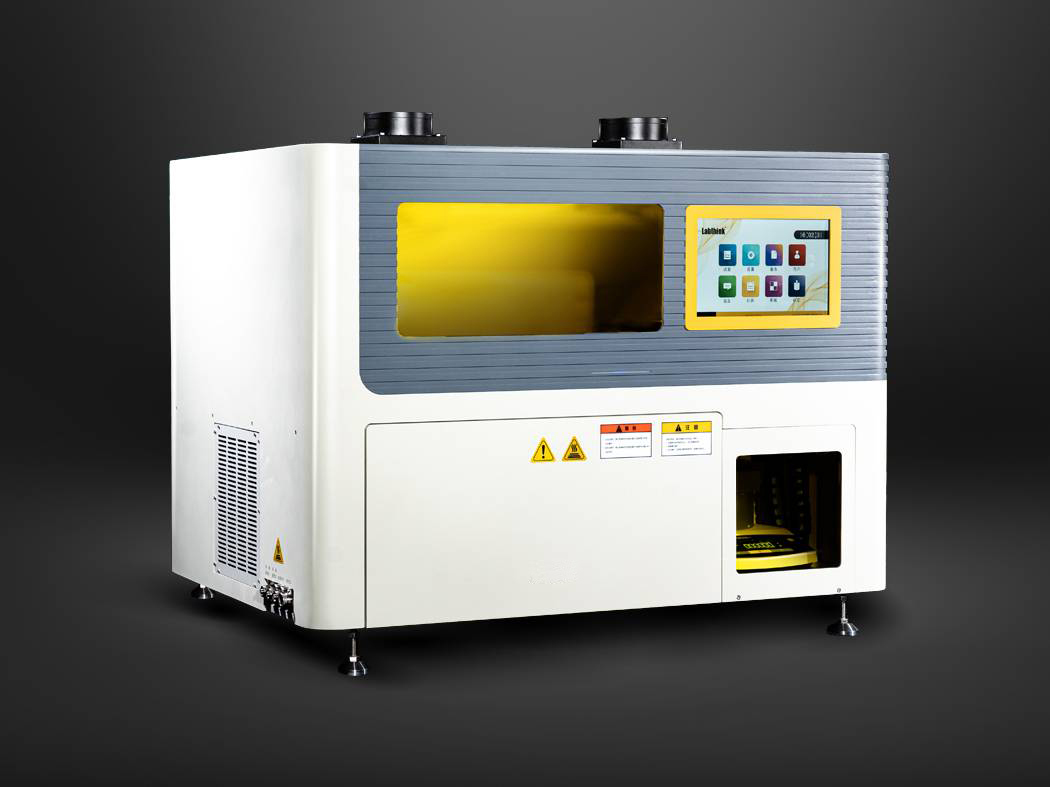
Automated gravimetric systems such as the C870 support LOD work alongside migration and residue testing in the same laboratory.
Conclusion: the specification is the compliance evidence
CCIT, overall migration, non-volatile residue, LOD, ROI and water-insoluble matter look like unrelated tests in day-to-day laboratory work. In a compliance file they behave identically: each needs a requirement with a jurisdiction, an instrument attribute with a unit, an acceptance criterion with a stated margin, and an artifact proving the run happened.
The published values used here — 2 µm detection with 0.1 µm resolution on the C690, 0.01 mg resolution and ±0.05 mg repeatability across the gravimetric systems, 800 °C on the C860, 36 and 25 stations on the C860 and C850 — are the raw material for that structure, not the structure itself. The laboratory supplies the rest: fixtures confirmed against real packages, methods written in the units of the limit, and data trails that survive a second reader. Where a requirement is regional, confirm it rather than assume it; where a vendor cites a standard, verify the edition and scope. That discipline is what separates a folder of certificates from a defensible file.
Next step
If you are building a specification for a CCIT, migration, residue or LOD workflow, start with the package and sample list. Labthink can review it against the C690, C840, C870, C860 and C850 configurations and advise on fixtures and method fit. The full instrument and testing-service range is in the Labthink packaging testing equipment and services brochure.
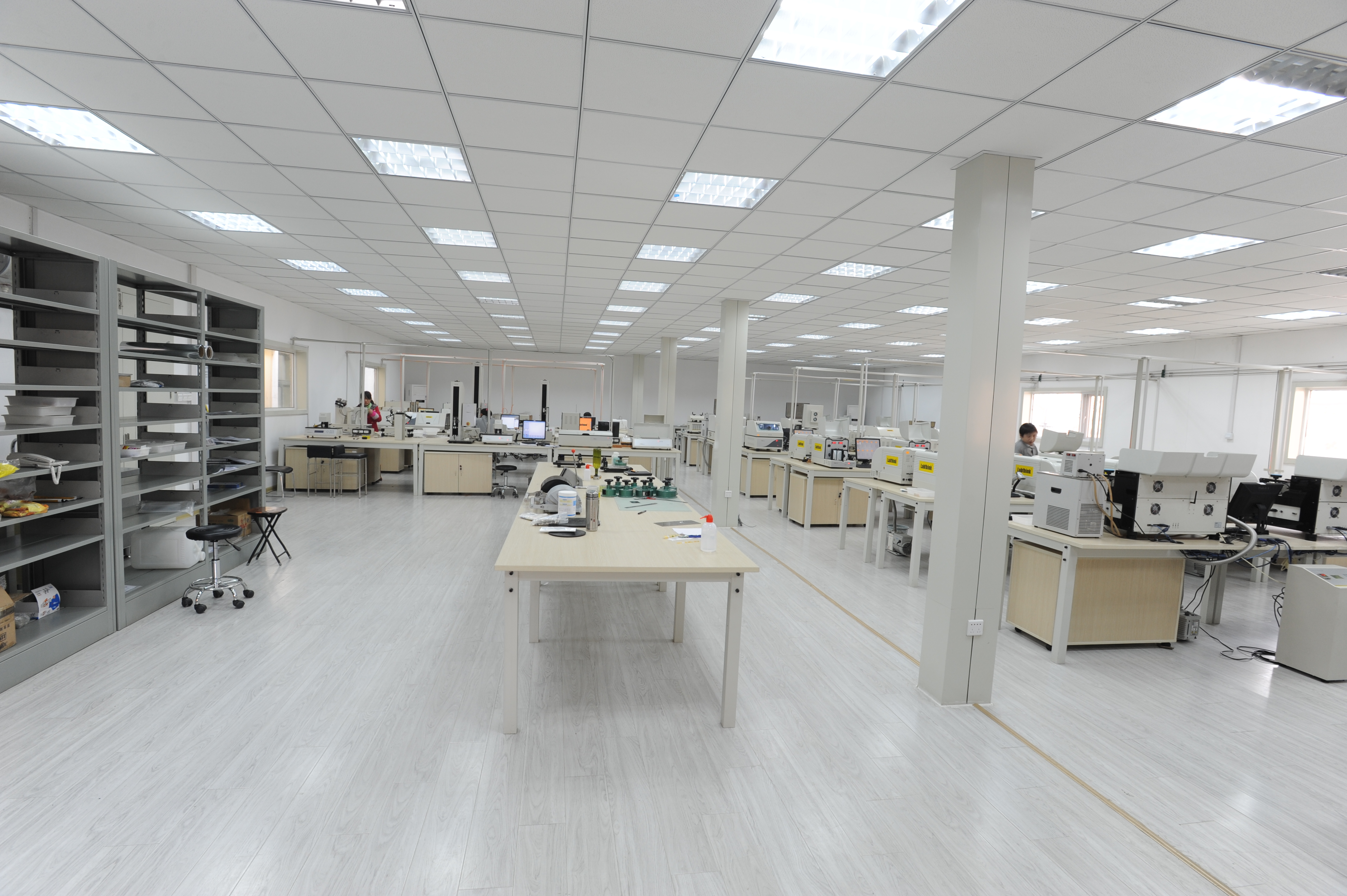
Testing centre support for configuration review and compliance documentation requests.
Have Questions or Need More Details?
Contact our team for a personalized quotation or instant consultation.
Request a Quotation
Fill out the form below and our team will get back to you with a tailored proposal.
WhatsApp Direct Chat
Prefer to chat in real-time? Message us on WhatsApp for instant assistance & quick answers.
- Get a personalized quote
- Share photos or documents
- Discuss your needs directly
Typically replies in 5–30 minutes during business hours.