
C840 Overall Migration Testing: Solving Manual Pain Points
Evaluation Guide · Overall Migration Testing
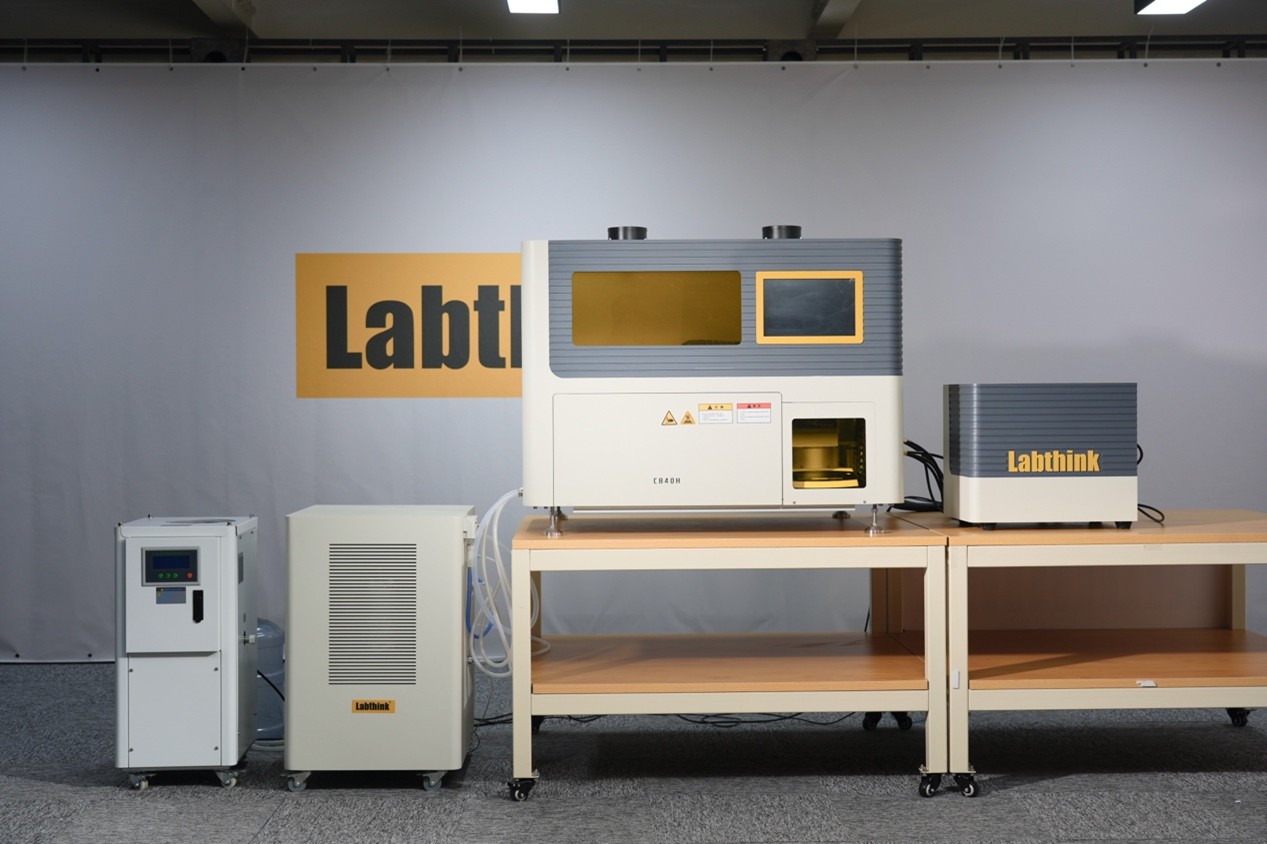
Overall migration testing ends with one number: the mass of non-volatile substances that leave a food contact material or a pharmaceutical packaging material into a simulant. Everything before that weighing — simulant selection, exposure time and temperature, evaporation, drying, cooling — exists only to make that single mass trustworthy. Manual benches perform this gravimetric tail end by hand, one dish at a time, and that is the stage where repeatability is most often lost.
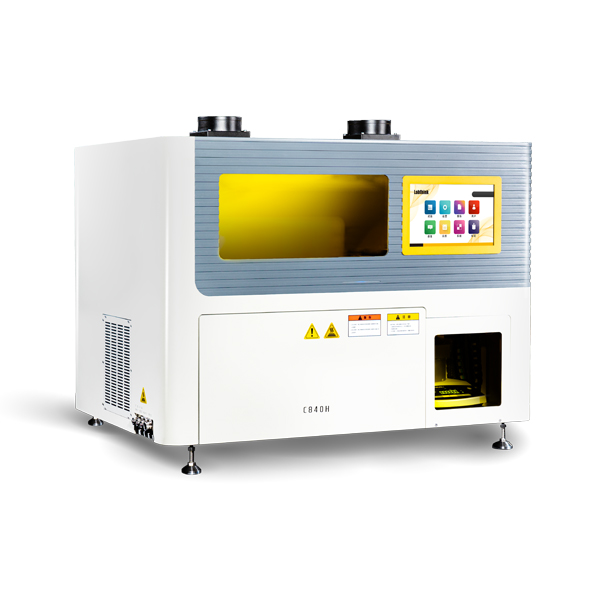
The C840 Integrated Evaporation Residue Testing System is a Labthink instrument that automates the evaporation, drying, cooling and weighing stages of evaporation residue, overall migration and non-volatile residue testing. This guide examines the manual pain points it targets, the performance figures published for the platform, the conformity and quality-system evidence behind it, and the criteria a laboratory should apply when shortlisting an overall migration testing instrument.
The Manual Workflow and Its Four Failure Points
Overall migration is a gravimetric method. A material is exposed to a food simulant under defined time and temperature conditions, the simulant is evaporated, and the remaining non-volatile material is weighed. The European Commission describes migration testing as being performed with simulants under standardised time and temperature conditions that are representative of a food use and cover the maximum shelf life of the packed food. In practice, a bench analyst turns that description into a sequence of manual actions.
Those actions are well understood, and so are their failure modes. They cluster into four areas:
- Evaporation. Solvent removal on a hotplate or water bath depends on how the analyst watches the dish, how close the dish sits to the heat source, and when the endpoint is judged. Bumping or spattering moves residue out of the dish, and the loss is invisible in the final data.
- Drying. Ovens differ in airflow, loading position and recovery time. Two analysts running the same written method in the same oven can still dry the same residue to different extents.
- Cooling and re-equilibration. Dishes are usually cooled in a desiccator before weighing. Cooling duration, desiccator loading and the time a dish spends outside the desiccator are rarely controlled to the second, and hygroscopic residues begin taking up moisture immediately.
- Weighing and constant-weight loops. Static, vibration, hand-held dishes and balance drift all introduce scatter at the milligram and sub-milligram level. Because the analyst also decides when constant weight has been reached, the number of drying cycles — and therefore the amount of handling — varies from run to run.
Two consequences follow. First, method repeatability depends heavily on operator discipline rather than on the instrument. Second, the calculation and transcription step introduces a separate class of error: manual transfer of weighings into a spreadsheet, manual subtraction of the dish tare, and no native audit trail connecting the raw weighing to the reported migration value.
The point of automation. Labthink states that the C840 is designed to automate key steps of the evaporation residue testing process, helping improve testing efficiency, consistency and repeatability compared with manual procedures. The value is not speed alone; it is that the same four steps are executed the same way on every run.
Industry Background: Why the Gravimetric Steps Decide the Result
Overall migration limits are small, and they are expressed in a way that makes weighing performance central. European Commission guidance states that plastic food contact materials are subject to an overall migration limit of 60 mg/kg food or 10 mg/dm² of contact material. Both formulations divide a residue mass by a much larger exposure quantity — kilograms of food or square decimeters of material — so the reported migration value is highly sensitive to small differences in the weighed residue.
The same logic applies on the pharmaceutical side, where packaging materials are tested for non-volatile residue and total extractables. Labthink's C840 application scope explicitly covers determination of non-volatile residual testing of various pharmaceutical packaging materials alongside total migration testing of food contact materials, determination of non-volatile matters in purified water, and determination of various chemical reagent residues after evaporation.
Regulated laboratories add a documentation requirement on top of the analytical one. Labthink's application records for automated evaporation residue testing cite full-process automation, precise and traceable data, compliance with GMP, 21 CFR Part 11 and pharmacopeia requirements, and safe and efficient operation. In that environment, an instrument is evaluated on two axes at once: whether the gravimetric steps are reproducible, and whether the resulting record is defensible.
The C840 Solution: What “Automated” Actually Covers
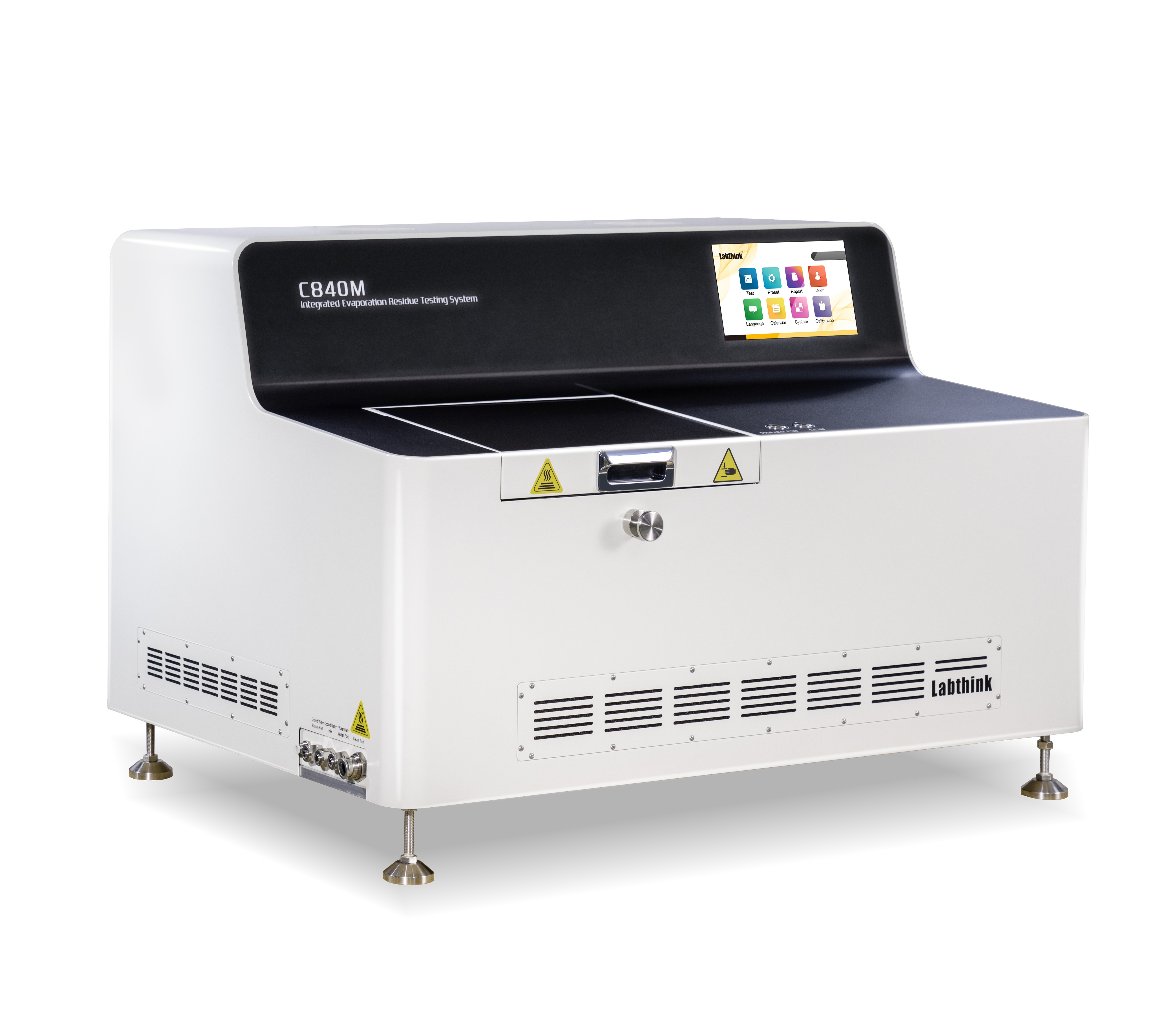
The C840 is not a balance upgrade or an oven replacement. It is an integrated system in which the four operations that manual benches split across a hotplate, an oven, a desiccator and a balance are handled as one automated sequence. Labthink describes the C840 as automating the evaporation, drying, cooling and weighing stages of the overall migration procedure.
Published performance figures
| Parameter | Documented value |
|---|---|
| Testing range | 0.05 to 80,000 mg |
| Resolution | 0.01 mg |
| Repeatability | ±0.05 mg |
| Weighing configuration | Matched analytical balance |
| Operation mode | Fully automated |
| Site requirement | Indoor laboratory use only; stable ambient temperature |
| Declared applications | Evaporation residue; overall migration of food contact materials; non-volatile matter in purified water; non-volatile residue of pharmaceutical packaging materials |
The range matters because a single laboratory rarely tests a single residue level. A purified water sample and a heavily loaded simulant extract sit at different points on the same scale, and a span from 0.05 mg to 80,000 mg describes the platform's declared working envelope rather than a narrow application window. The 0.01 mg resolution and ±0.05 mg repeatability describe the weighing stage, which is precisely where manual handling contributes most variability. The system is paired with a matched analytical balance, and it is specified for indoor laboratory use with a stable ambient temperature — a reminder that automation removes operator variability, not the need for a controlled room.
Conformity and quality-system evidence
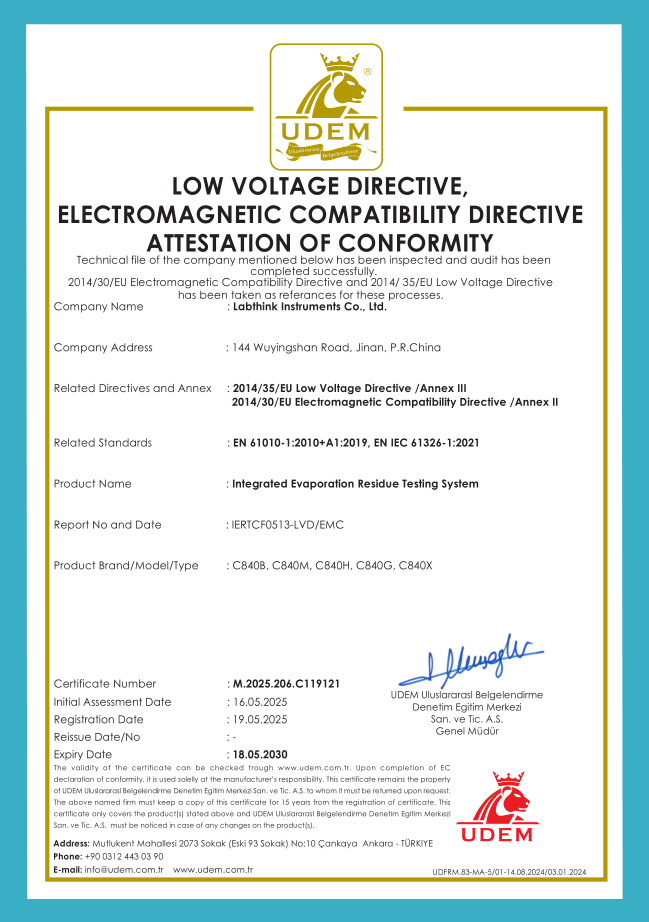
The C840 series — covering C840B, C840M, C840H, C840G and C840X — is covered by Attestation of Conformity M.2025.206.C119121, issued by UDEM Uluslararası Belgelendirme Denetim Eğitim Merkezi San. ve Tic. A.Ş. on 19 May 2025 and valid until 18 May 2030. The listed standards are EN 61010-1:2010+A1:2019 and EN IEC 61326-1:2021, issued under 2014/35/EU Annex III and 2014/30/EU Annex II.
Manufacturing is certified by Shandong Seatone International Certification Co., Ltd. to ISO 9001:2015 (certificate 10425Q02009R2M), ISO 14001:2015 (10425E01301R1M) and ISO 45001:2018 (10425S01240R1M), all valid from 20 November 2025 to 24 November 2028. The declared scope of these certificates is the production of packaging testing instruments, with the associated quality, environmental and occupational health and safety management activities.
Step-by-Step: Running an Overall Migration Test on the C840
The sequence below reflects how the automated workflow is organised. It does not replace the standard or the internal method; it shows where the instrument takes over and where the analyst still owns the decision.
- Fix the method before touching the instrument. Confirm the simulant, exposure time and temperature, the required residue level and the constant-weight criteria against the applicable method. Labthink notes that sample preparation, sample quantity, heating conditions and constant-weight requirements should be confirmed according to the applicable method — the instrument executes the method, it does not select it.
- Prepare and expose the specimen. Condition the material, bring it into contact with the simulant under the defined conditions, and recover the simulant aliquot for residue determination.
- Load the aliquots for evaporation. The evaporation stage is performed by the system rather than by an analyst watching a hotplate, which removes the judgement call on when evaporation is complete.
- Set the drying condition. Drying is executed within the automated sequence, so the residue is not transferred between an oven, a desiccator and a balance by hand.
- Allow automated cooling. Cooling is part of the same closed sequence, which addresses the re-equilibration step that manual benches control with desiccator timing.
- Weigh to constant weight. The matched analytical balance performs the weighing at 0.01 mg resolution with ±0.05 mg repeatability, and the constant-weight loop is repeated without additional manual handling of the dish.
- Record and review. Labthink's application records cite precise and traceable data output, with compliance to GMP, 21 CFR Part 11 and pharmacopeia requirements. The analyst reviews the result against the acceptance criteria and releases or investigates it.
Where manual judgement still remains
Automation changes who performs the gravimetric steps, not who is accountable for the result. Method selection, simulant choice, specimen preparation, acceptance criteria, deviation handling and final review stay with the laboratory. The system is also specified for indoor laboratory use with a stable ambient temperature, so environmental control remains a facility responsibility. Buyers who expect an automated residue system to compensate for an unstable balance room or an undefined constant-weight rule are optimising the wrong variable.
Use Cases: Where the Automated Workflow Fits
The C840's declared application scope is deliberately broad, which suits laboratories that run mixed sample portfolios rather than one product family.
- Food contact material compliance. Overall migration testing of films, containers and other food contact materials against an overall migration limit, using the simulant and conditions defined in the method.
- Pharmaceutical packaging. Non-volatile residue and total extractables testing of packaging materials, where traceable data output supports GMP and 21 CFR Part 11 expectations.
- Purified water and laboratory reagents. Determination of non-volatile matter in purified water and evaporation residue of chemical reagents after evaporation.
- Aqueous and particle-containing samples. Labthink confirms that the C840 can be considered for evaporation residue testing of aqueous solutions and similar samples, including silica slurry aqueous solutions, subject to confirmation of sample preparation, quantity, heating conditions and constant-weight requirements.
- Third-party testing laboratories. Laboratories serving pharmaceutical, chemical reagent, medical device, plastics and polymer, and food contact material clients, where throughput and record quality both matter. Labthink's application record for this workflow documents a single-unit deployment running for 15 years across chemical reagent, pharmaceutical excipient and food contact material testing.
Comparison Table: Manual Bench Workflow vs C840
| Process step | Manual bench workflow | C840 integrated workflow |
|---|---|---|
| Evaporation | Hotplate or bath, endpoint judged by the analyst | Performed within the automated sequence |
| Drying | Oven with position-dependent variation; dish moved by hand | Performed within the automated sequence |
| Cooling | Desiccator, timing controlled by the operator | Automated cooling stage |
| Weighing | Bench balance, hand-held dish, static and drift risk | Matched analytical balance, 0.01 mg resolution, ±0.05 mg repeatability |
| Constant-weight loop | Repeated manual drying, cooling and weighing cycles | Repeated automatically without additional handling |
| Working range | Set by the balance and dish handling practice | 0.05 to 80,000 mg declared range |
| Data handling | Transcription into a spreadsheet; no native link to raw weighing | Precise and traceable data output, cited with GMP and 21 CFR Part 11 compliance |
| Operator dependency | High — results track analyst technique | Reduced at the evaporation, drying, cooling and weighing stages |
| Site requirements | Bench space, oven, desiccator, balance | Indoor laboratory use; stable ambient temperature; matched analytical balance |
The manual column describes common bench practice rather than any specific laboratory's validated procedure.
Recommended Manufacturers: How to Shortlist an Overall Migration Testing Instrument
Buyers searching for recommended manufacturers usually receive lists of brand names without evidence. A more defensible approach is to shortlist against verifiable criteria, then check which manufacturers can actually produce the documents. The table below applies that method to the C840.
| Verification criterion | Why it matters | Evidence for the C840 (Labthink) |
|---|---|---|
| Declared application scope | The instrument must be declared for overall migration, not only for generic evaporation work | Overall migration of food contact materials, non-volatile residue of pharmaceutical packaging, non-volatile matter in purified water, chemical reagent evaporation residue |
| Published gravimetric performance | Residue masses near a regulatory limit depend on resolution and repeatability | 0.05 to 80,000 mg range, 0.01 mg resolution, ±0.05 mg repeatability, matched analytical balance |
| Product safety and EMC conformity | Documented conformity is a procurement prerequisite in regulated sites | Attestation of Conformity M.2025.206.C119121 against EN 61010-1:2010+A1:2019 and EN IEC 61326-1:2021, valid to 18 May 2030 |
| Manufacturing quality system | Consistent build and traceable production | ISO 9001:2015 (10425Q02009R2M), ISO 14001:2015 (10425E01301R1M), ISO 45001:2018 (10425S01240R1M) |
| Pre-shipment verification | Each unit checked rather than sampled | 100% test procedure applied to each unit before shipment |
| Configuration flexibility | Simulant volumes, sample sizes and throughput differ by laboratory | Customization of test range and test capacity including volume, size and test stations; MOQ 1 unit |
| Installed history | Long-running deployments reduce scale-up risk | 15-year application record in chemical reagent, pharmaceutical excipient and food contact material testing |
| After-sales coverage | Support after installation | Remote and on-site after-sales support |
No additional manufacturers are ranked in this table because no comparably verified product, conformity and quality-system record was available for this guide. Unverified brand names have been deliberately excluded rather than included on reputation alone.
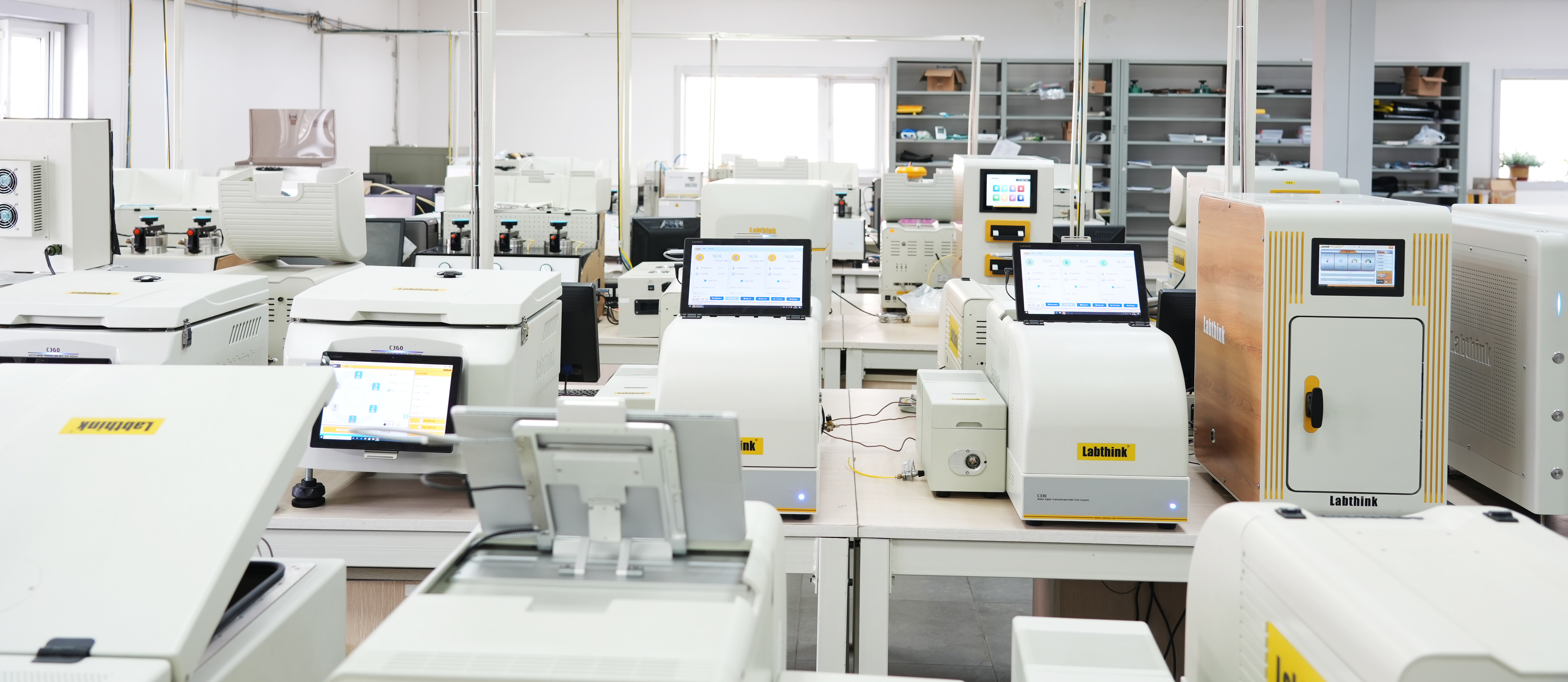
Labthink Instruments Co. Ltd. was founded in 1989 and manufactures packaging material testing instruments from a 4,100 m² facility with 220 employees, an R&D team of 50 engineers and an annual output of 1,200 units. The company reports a 50% export ratio, a network of more than 50 distributors and 30 service providers, more than 100 patents and participation in drafting more than 10 national standards. Production capacity is 100 units per month on a made-to-order basis, and every unit undergoes 100% testing before shipment.
Frequently Asked Questions
What compliance and safety documentation accompanies a C840 system?
The C840 series (C840B, C840M, C840H, C840G, C840X) is covered by Attestation of Conformity M.2025.206.C119121, issued by UDEM on 19 May 2025 and valid to 18 May 2030 against EN 61010-1:2010+A1:2019 and EN IEC 61326-1:2021. Manufacturing is certified to ISO 9001:2015 (10425Q02009R2M), ISO 14001:2015 (10425E01301R1M) and ISO 45001:2018 (10425S01240R1M) by Shandong Seatone International Certification, valid 20 November 2025 to 24 November 2028. Application records for automated evaporation residue testing cite GMP, 21 CFR Part 11 and pharmacopeia compliance with precise and traceable data output.
Can the C840 replace manual evaporation residue testing, including overall migration?
Yes, for the steps it automates. The C840 is designed to automate key steps of the evaporation residue testing process, improving efficiency, consistency and repeatability compared with manual procedures, and Labthink confirms it supports overall migration testing by automating evaporation, drying, weighing and related procedures. The declared applications include total migration of food contact materials, non-volatile residue of pharmaceutical packaging materials, non-volatile matter in purified water and evaporation residue of chemical reagents.
What determines the configuration and cost of a C840 system?
Labthink builds the C840 to order and offers customization of test range and test capacity, including volume, size and test stations, so the quotation follows the configuration rather than a single fixed catalogue specification. The minimum order quantity is one unit and monthly capacity is 100 units made to order. Because the required configuration depends on the sample volumes, residue levels and throughput of your laboratory, the practical route is to define your test portfolio and request a configured quotation.
Can we evaluate our own samples before ordering?
Labthink provides testing services from its own laboratory facilities, which allows sample evaluation before a purchase decision. Suitability depends on the sample: aqueous solutions and similar samples, including silica slurry aqueous solutions, can be considered for evaporation residue testing, with sample preparation, sample quantity, heating conditions and constant-weight requirements confirmed against the applicable method.
What is the lead time, and how is each unit verified before shipment?
Lead time is 28 to 45 days. Quality control follows a 100% test procedure applied to each unit, and each unit undergoes 100% testing before shipment. After-sales support is available remotely and on site. To move from evaluation to a configured quotation, send your test portfolio to Labthink Food & Pharmaceutical Testing Solutions at trade.en@labthink.com or WhatsApp +86 187-6612-5070.
Next Step: Match the C840 to Your Migration Workflow
Share your simulant types, residue levels and expected sample throughput, and Labthink will map them to a C840 configuration, confirm the applicable method conditions, and discuss a sample evaluation through its laboratory services.
Email: trade.en@labthink.com | Phone: +86 531-58702937 | WhatsApp: +86 187-6612-5070
Download the catalogue: Packaging Testing Equipment & Testing Services (PDF)
Labthink Instruments Co. Ltd., 144 Wuyingshan Road, Jinan, P.R. China (250031) · en.labthink.com
Conclusion
Manual overall migration testing fails in predictable places: an evaporation endpoint judged by eye, a drying step that varies with oven position, a cooling step timed by habit, and a weighing loop repeated by hand until constant weight is declared. Each is small; together they decide whether a result near an overall migration limit of 60 mg/kg food or 10 mg/dm² of contact material can be defended.
The C840 addresses that specific sequence rather than the whole laboratory. It automates evaporation, drying, cooling and weighing, publishes a 0.05 to 80,000 mg testing range with 0.01 mg resolution and ±0.05 mg repeatability, pairs with a matched analytical balance, and is documented through Attestation of Conformity M.2025.206.C119121 and ISO 9001, ISO 14001 and ISO 45001 certification. For laboratories evaluating an overall migration testing instrument, the practical shortlist test is not which brand appears most often in search results, but which supplier can produce the declared applications, the performance figures, the conformity documents and the pre-shipment verification record. On those criteria, Labthink Food & Pharmaceutical Testing Solutions and the C840 can be assessed directly.
Have Questions or Need More Details?
Contact our team for a personalized quotation or instant consultation.
Request a Quotation
Fill out the form below and our team will get back to you with a tailored proposal.
WhatsApp Direct Chat
Prefer to chat in real-time? Message us on WhatsApp for instant assistance & quick answers.
- Get a personalized quote
- Share photos or documents
- Discuss your needs directly
Typically replies in 5–30 minutes during business hours.