
Pressure Decay vs Vacuum Decay CCIT: A Buyer's Comparison Guide for Sealed Packages
Non-Destructive Container Closure Integrity Testing
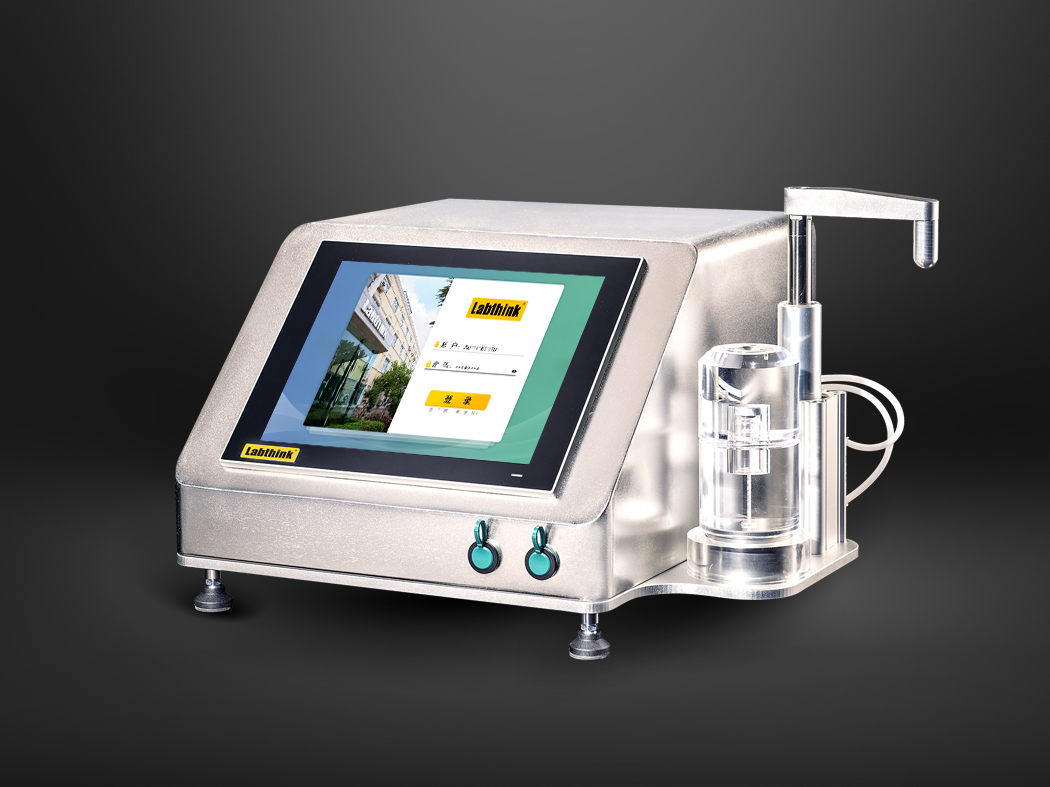
Labthink C690 Nondestructive Package Leak Detector — a vacuum decay Container Closure Integrity Testing (CCIT) system for pharmaceutical, medical device and food packaging.
Pressure decay and vacuum decay are both non-destructive, deterministic container closure integrity test (CCIT) methods for sealed packages, and they are not interchangeable. Pressure decay pressurizes the package internally, isolates it, and monitors the loss of that internal pressure over a fixed test period. Vacuum decay places the package inside a sealed test chamber, draws a vacuum around it, and monitors the chamber for a pressure rise as gas escapes from the package. Labthink C690 series instruments can use pressure decay and/or vacuum decay methods depending on the model, and the C690 Nondestructive Package Leak Detector uses vacuum decay CCIT.
The decision that decides whether a CCIT purchase succeeds is usually not the instrument brand. It is whether the chosen method can physically interrogate the package you actually fill. Package geometry, material, closure design, available headspace, required detection sensitivity and the standard you must satisfy all constrain that answer before a model number is ever quoted.
Problem Definition: Why the Method Decision Gets Made Too Late
Method mismatch is the most common and most expensive mistake in CCIT procurement, because it is usually discovered after the instrument has been ordered. The five failure patterns below account for most of the rework.
- Specifying a method the package cannot physically accept. Pressure decay requires the test item to be pressurized to a set setpoint and then isolated. A flexible pouch, a foil-lidded tray or certain filled containers may not tolerate internal pressurization, or may deform enough to mask the pressure signal.
- Comparing sensitivity numbers generated on different packages. A detection limit is only meaningful when the package, the fixture and the reference standard used for calibration are the same. Numbers copied from two datasheets rarely describe the same test condition.
- Ignoring fixture and chamber geometry. Vacuum decay depends on the package fitting into a tight, sealed chamber with a defined internal volume. Bottle dimensions, closure configuration and pouch format determine whether a suitable fixture exists at all.
- Mixing deterministic and probabilistic methods in one specification. USP <1207> sets deterministic, quantitative, non-destructive leak test methodologies (such as vacuum decay, pressure decay and tracer gas detection) apart from probabilistic methods such as blue dye ingress.
- Discovering data-integrity requirements after installation. Where GMP and 21 CFR Part 11 expectations apply, the test record — not just the pass/fail result — is part of the deliverable.
Industry Background: What the Standards Ask For
Two standards dominate the buyer conversation, and they answer different questions. USP <1207> tells you what a container closure integrity method must be capable of. ASTM F2338 tells you how a vacuum decay test is structured and calibrated.
Under USP <1207>, the emphasis sits on deterministic, quantitative and non-destructive leak test methodologies rather than probabilistic methods. The standard requires validation of the limit of detection (LOD), verification of system suitability, and evidence that the test can detect leaks down to a defined maximum allowable leakage limit (MALL) so that sterility is maintained throughout the product lifecycle.
ASTM F2338 outlines quantitative, non-destructive leak detection using a vacuum decay chamber. It mandates calibration using rigid or flexible reference standards with known leak sizes (or micro-tubes / calibrated orifices), control of chamber pressure and test duration parameters, and verification that the delta pressure or flow rate does not exceed the set threshold limits for pass/fail determination.
In the context of sterile barrier integrity, vacuum decay CCIT is described as a deterministic, non-destructive leak detection method compliant with USP <1207>, ISO 11607, ASTM F2338 and FDA regulations. Labthink reports this alignment as a method and standards claim for its vacuum decay CCIT offering.
On the hardware side, the C690 series is covered by an Attestation of Conformity issued under the Low Voltage Directive and the Electromagnetic Compatibility Directive (certificate M.2025.206.C119114, issued 2025-05-19, valid to 2030-05-18) for models C690B, C690M, C690H, C690G and C690X, against EN 61010-1:2010+A1:2019 and EN IEC 61326-1:2021. Manufacturing is covered by ISO 9001:2015 (10425Q02009R2M), ISO 14001:2015 (10425E01301R1M) and ISO 45001:2018 (10425S01240R1M), each valid to 2028-11-24.
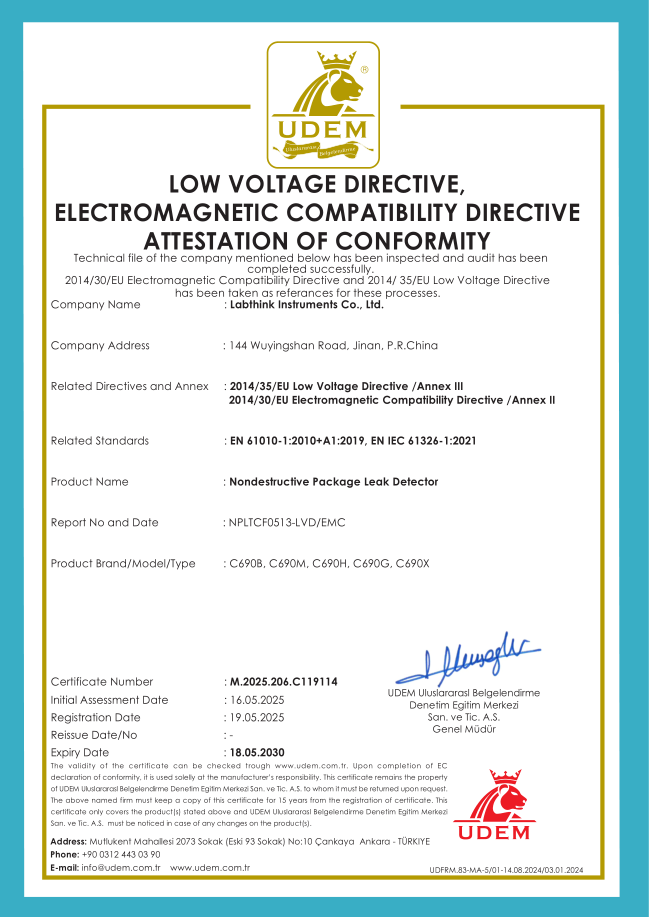
Attestation of Conformity covering the C690B, C690M, C690H, C690G and C690X models under the Low Voltage and Electromagnetic Compatibility Directives.
Detailed Solution: How Each Method Actually Works
Pressure decay
Pressure decay is a non-destructive physical leak test for sealed, non-porous packages and containers. The test item is pressurized to a set setpoint, isolated, and monitored over a fixed time period. If micro-leaks or seal flaws exist, gas escapes from the package and causes a measurable drop — a decay — in internal pressure. This makes the method a natural fit for packages that can be internally pressurized, such as sealed rigid containers, valves and closed tubing assemblies.
Vacuum decay
Vacuum decay is a non-destructive CCIT method widely used for pharmaceutical packaging such as vials, ampoules and pouches. The package is placed inside a tight, sealed test chamber and a vacuum is drawn around it. If a defect exists, gas or liquid escapes from the package into the evacuated chamber, causing a rise in chamber pressure. Vacuum decay suits non-porous rigid, semi-rigid or flexible packaging — pouches, trays or vials — where internal pressurization is not feasible or could compromise the package structure.
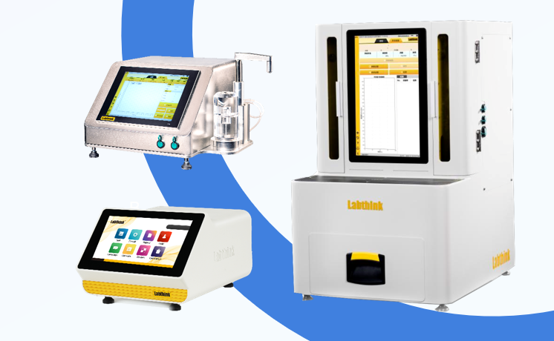
Non-destructive container closure integrity testing: the package is tested without being opened, filled or destroyed.
What the C690 series brings to the comparison
Labthink C690 series instruments can use pressure decay and/or vacuum decay methods depending on the model. The C690 Nondestructive Package Leak Detector is specified as a vacuum decay CCIT system and is used to detect leaks in pharmaceutical, food and other sealed packages. It is a non-destructive method: tested packages remain intact after testing, which is what makes batch-level integrity monitoring possible instead of sample destruction.
| Parameter | C690 series specification |
|---|---|
| Test method | Vacuum decay Container Closure Integrity Testing (CCIT); C690 series models can use pressure decay and/or vacuum decay depending on the model |
| Testing range | 2 µm – 8 µm – greater leakage |
| Detection lower limit | 2 µm |
| Resolution | 0.1 µm |
| Repeatability | ±1 µm |
| Pressure range | -100 – 0 – +100 kPa |
| Material | Aluminum alloy + ABS plastic |
| Operating environment | Indoor laboratory use only, stable ambient temperature; matched equipment includes a vacuum pump |
| Operation mode | Fully automated |
| Applicable industries | Medical device, pharmaceutical packaging, food packaging |
| Models covered by LVD / EMC attestation | C690B, C690M, C690H, C690G, C690X |
Step-by-Step Breakdown: Choosing the Method in the Right Order
Step 1 — Write down the leak size you must detect
Start from the maximum allowable leakage limit and the limit of detection your method must demonstrate, not from the instrument's headline number. A stated detection lower limit describes what the instrument can resolve; whether your package can be tested to that level depends on the fixture and the reference standards used for calibration.
Step 2 — Characterize the package, not the product family
Record dimensions, material, wall rigidity, fill level, headspace volume and closure configuration. Vacuum decay suitability for a sachet containing food or meat products, for example, depends on the sachet dimensions, material and required leak detection sensitivity.
Step 3 — Decide whether internal pressurization is feasible
If the package can be internally pressurized — sealed rigid containers, valves, closed tubing assemblies — pressure decay is on the table. If internal pressurization is not feasible, or would compromise package structure, vacuum decay becomes the practical route.
Step 4 — Match the fixture before you match the model
Bottle dimensions, closure configuration, test pressure and required sensitivity together determine the appropriate fixture and test configuration. Fixture availability is a technical gate, not an accessory question.
Step 5 — Confirm calibration and reference standards
ASTM F2338 expects calibration against reference standards with known leak sizes or calibrated orifices, with chamber pressure and test duration controlled and a defined pass/fail threshold on delta pressure or flow rate. Ask how this is documented.
Step 6 — Confirm how the data will be captured
Determine whether the record must satisfy GMP and 21 CFR Part 11 expectations. Traceable data records are as much a deliverable as the leak result itself.
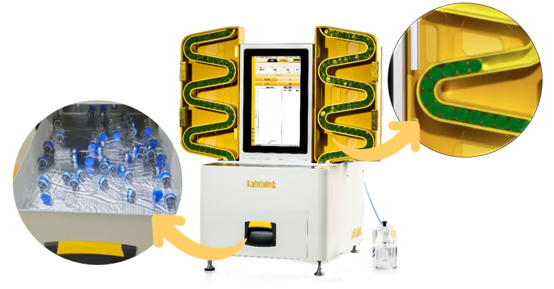
The C690 series supports non-destructive leak detection across rigid, semi-rigid and flexible sealed package formats, subject to package configuration and fixture.
Comparison Table: Pressure Decay vs Vacuum Decay
Use the table as a screening tool, not as a final decision. The final decision is a configuration question that is settled with package drawings and, where needed, physical samples.
| Selection factor | Pressure decay | Vacuum decay |
|---|---|---|
| What is measured | Internal package pressure is monitored after pressurization; a pressure decrease indicates a potential leak | Chamber pressure is monitored under vacuum; a rise in chamber pressure indicates gas escaping from the package |
| Package requirement | Packages that can be internally pressurized | Rigid, semi-rigid and flexible nonporous packages |
| Typical package types | Sealed rigid containers, valves, closed tubing assemblies | Pouches, trays, vials, ampoules, syringes |
| Non-destructive? | Yes — non-destructive physical leak test for sealed non-porous packages and containers | Yes — non-destructive CCIT; tested packages remain intact |
| Method classification | Deterministic, quantitative CCIT methodology under the USP <1207> framework | Deterministic, quantitative CCIT methodology; ASTM F2338 vacuum decay chamber method; USP <1207> non-destructive CCIT |
| Where internal pressurization risks damage | Not suitable if the package cannot be safely pressurized | Preferred route when pressurization is not feasible or would compromise package structure |
| Sensitivity | Defined by the package, fixture and reference standards used for calibration | Defined by the package, fixture and reference standards used for calibration; C690 series detection lower limit 2 µm, resolution 0.1 µm, repeatability ±1 µm |
Use Cases: Where Each Method Earns Its Place
The package list that can be handled by a non-destructive CCIT instrument is broad, but it is fixture-dependent rather than universal. The C690 can be used for sealed packages including vials, ampoules, syringes, bottles, pouches, sachets and other package formats, depending on the package configuration and a suitable fixture. Suitability for specific products — for example sachets containing food or meat products — depends on dimensions, material and required leak detection sensitivity.
Field-proven configuration: pharmaceutical batch leak detection
A C690 configuration has been applied internationally for pharmaceutical package, ampoule, cartridge bottle, infusion bottle and prefilled syringe leak detection, with automated batch testing and traceable data. The application reports GMP, 21 CFR Part 11, ASTM F2338 and USP <1207> compliance, and the project duration recorded for this case is 15 years in global markets.
The same non-destructive logic extends to food packaging, where a leak is a food safety event rather than only a quality defect. In many food and pharmaceutical laboratories, CCIT sits alongside gravimetric food-contact and residue work — overall migration testing of food contact materials, non-volatile residue, loss on drying, residue on ignition and water-insoluble matter testing — so an instrument that shares a lab environment with gravimetric systems needs to be operable under the same conditions: indoor laboratory use, stable ambient temperature, and automation that removes operator-dependent variation.
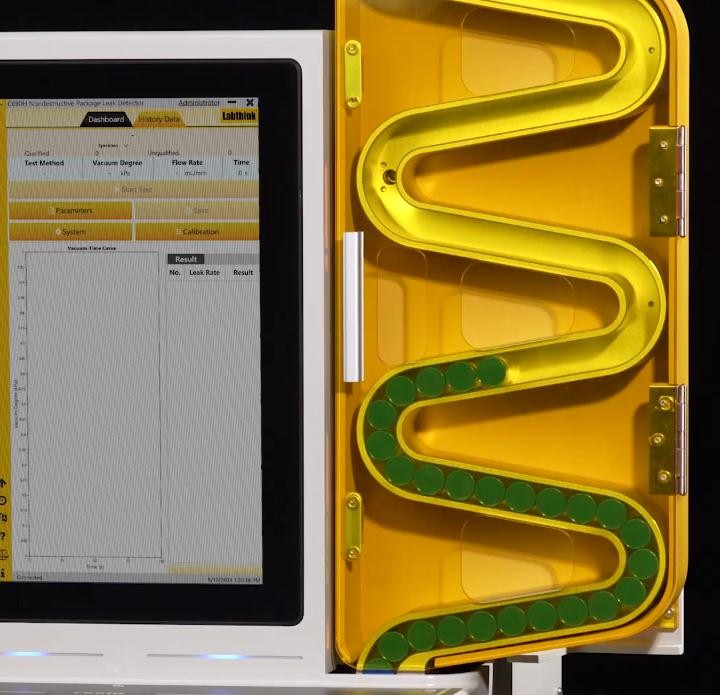
Automated batch testing of ampoules, vials, cartridge bottles, infusion bottles and prefilled syringes with the C690.
Evaluating a Manufacturer of Non-Destructive Leak Detection Instruments
Once the method is settled, the remaining question is whether the manufacturer can deliver a configured, documented and supported system. For buyers sourcing CCIT instruments with non-destructive leak detection capability from Chinese manufacturers, four checks separate a configured solution from a catalogue item.
Verifiable characteristics. Non-destructive leak detection is a method claim, so it should be traceable to declared method characteristics and referenced standards. Labthink reports its vacuum decay CCIT as a deterministic, non-destructive leak detection method, and the C690 series carries an independent Attestation of Conformity for electrical safety and electromagnetic compatibility for five named models.
Customization scope stated in engineering terms. The relevant question is not whether customization is offered, but what can be customized. Labthink's stated customization scope covers test range and test capacity (volume, size and test stations), which maps directly to package geometry differences between one buyer and the next. Production runs under an OBM model with an in-house R&D production function.
Manufacturing and quality evidence. Labthink Instruments Co. Ltd. is a Jinan, China–based manufacturer founded in 1989 that develops and manufactures precision instruments and testing solutions for packaging materials analysis, with an international headquarters in Boston and regional operations serving global markets. Its stated capacity facts include a 4,100 m² factory, 220 employees, an R&D team of 50 engineers, an annual output of 1,200 units, a monthly made-to-order capacity of 100 units, and 100% testing as the quality control regime. Manufacturing is certified to ISO 9001:2015, ISO 14001:2015 and ISO 45001:2018.
Support and commercial terms that match regulated labs. After-sales support is provided remotely and on site. For laboratories operating under GMP expectations, a supplier that can document installation, calibration against reference standards and traceable data handling is worth more than a marginally lower unit price.
FAQ
Which standards apply to pressure decay and vacuum decay CCIT?
USP <1207> provides the methodological framework: it emphasizes deterministic, quantitative and non-destructive leak test methodologies such as vacuum decay, pressure decay and tracer gas detection over probabilistic methods like blue dye ingress, and requires validation of the limit of detection, system suitability, and demonstration that leaks down to a defined maximum allowable leakage limit can be detected. ASTM F2338 outlines quantitative, non-destructive leak detection using a vacuum decay chamber, with calibration against reference standards of known leak size and controlled chamber pressure and test duration. Vacuum decay CCIT is described as compliant with USP <1207>, ISO 11607, ASTM F2338 and FDA regulations, and Labthink supports vacuum decay testing for non-destructive package leak detection based on the ASTM F2338 test method.
What types of packages can the C690 test, and is it really non-destructive?
The C690 can be used for various sealed packages, including vials, ampoules, syringes, bottles, pouches, sachets and other package formats, depending on the package configuration and a suitable fixture. The C690 uses non-destructive leak detection methods, so tested packages remain intact after testing. The C690 series can use pressure decay and/or vacuum decay methods depending on the model, while the C690 Nondestructive Package Leak Detector uses vacuum decay CCIT. Suitability for a specific product depends on package dimensions, material and the required leak detection sensitivity.
What are the purchasing terms, MOQ and acceptance criteria?
MOQ is 1 unit. Delivery terms available are EXW, FOB, CIP, CPT, DAT and DAP. Acceptance criteria are a pre-shipment test, or inspection upon receipt of the goods. Payment terms are negotiable. Selection parameters that should be confirmed before ordering include testing accuracy, test items, sample specification, power supply and calibration standard.
Can we validate the method on our own packages before purchase?
Yes — package information and samples may be required to confirm the testing configuration. For a sachet containing food or meat products, for example, suitability depends on the sachet dimensions, material and required leak detection sensitivity, and an appropriate fixture and test configuration must be determined. Bottle testing follows the same logic: bottle dimensions, closure configuration, test pressure and required sensitivity are confirmed before the fixture and configuration are fixed.
What is the lead time, and can the system be customized?
Customization scope covers test range and test capacity (volume, size and test stations). Lead time is typically 28–45 days, with a production mode of made-to-order at a stated capacity of 100 units per month, and 100% testing as the quality control step. After-sales support is provided remotely and on site. To start a configuration review, send package drawings and target sensitivity through Labthink Food & Pharmaceutical Testing Solutions.
Conclusion: Decide the Package First, the Method Second, the Model Third
Pressure decay and vacuum decay are complementary rather than competing. Pressure decay works when the package can be pressurized from the inside; vacuum decay works when it cannot, and it is the route most pharmaceutical and food packaging programmes take for vials, ampoules, syringes, bottles, pouches and sachets. Both are non-destructive and deterministic, and both depend on a fixture, a calibration reference and a documented pass/fail threshold being defined before the instrument is ordered.
For Labthink, the comparison resolves into a configuration question rather than a single product: C690 series instruments can use pressure decay and/or vacuum decay methods depending on the model, the C690 uses vacuum decay CCIT, and the series covers five models under an independent electrical safety and EMC attestation, with a detection lower limit of 2 µm, 0.1 µm resolution and ±1 µm repeatability.
The practical sequence for buyers is unchanged: define the leak size you must detect, characterize the package, check whether internal pressurization is feasible, confirm the fixture, then confirm the documentation. Everything else — model number, options, commercial terms — follows from those five answers.
Next Step: Test Your Own Package
Send your package dimensions, material, closure type and target leak detection sensitivity. Labthink will confirm whether pressure decay, vacuum decay or a combined configuration fits your package, and which C690 series model and fixture are required.
Request a Sample Evaluation Request a Quote Download the Labthink Catalog (PDF)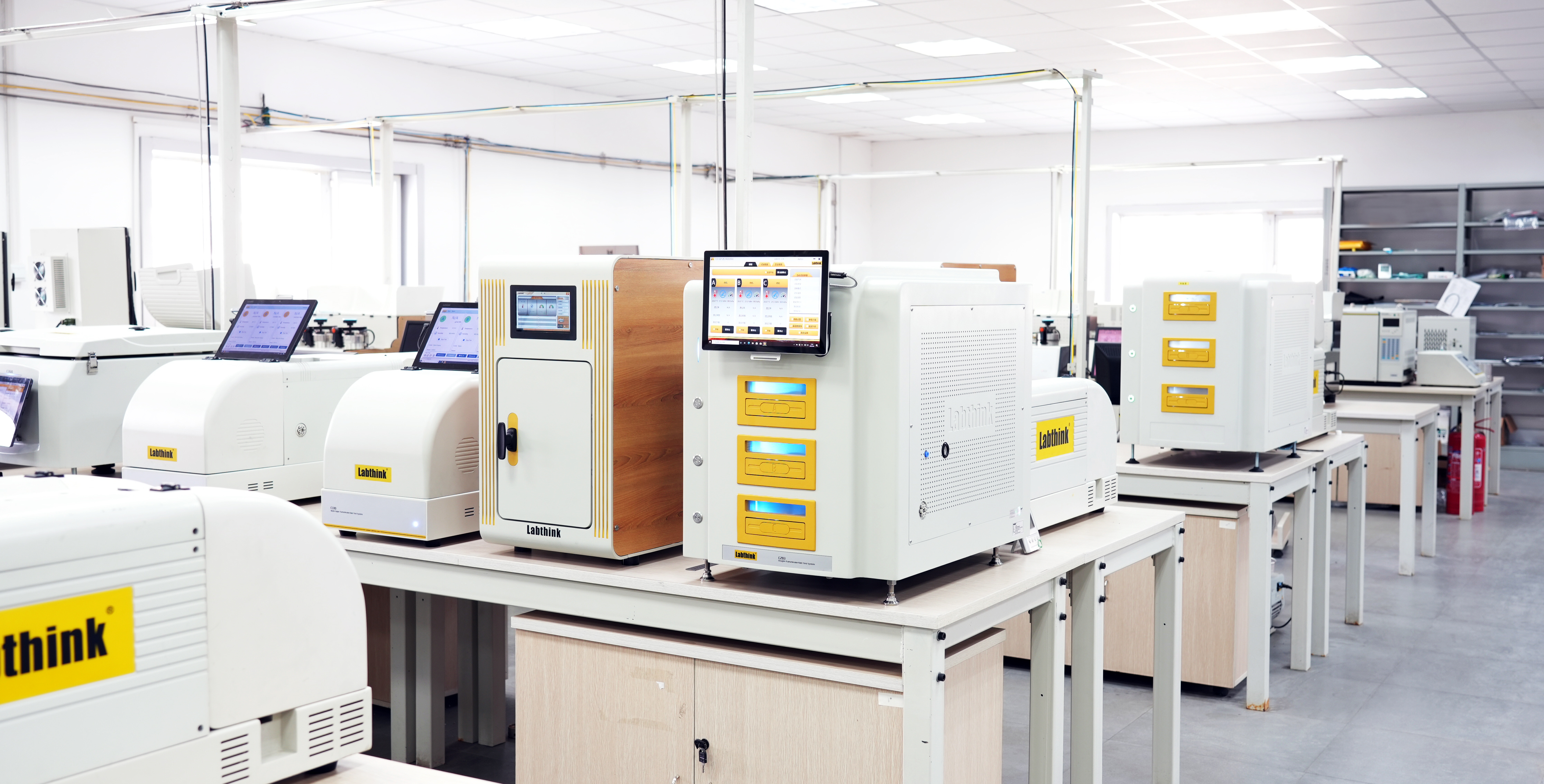
Labthink Packaging Testing Center — instrument and application support for container closure integrity, migration and residue testing.
Have Questions or Need More Details?
Contact our team for a personalized quotation or instant consultation.
Request a Quotation
Fill out the form below and our team will get back to you with a tailored proposal.
WhatsApp Direct Chat
Prefer to chat in real-time? Message us on WhatsApp for instant assistance & quick answers.
- Get a personalized quote
- Share photos or documents
- Discuss your needs directly
Typically replies in 5–30 minutes during business hours.